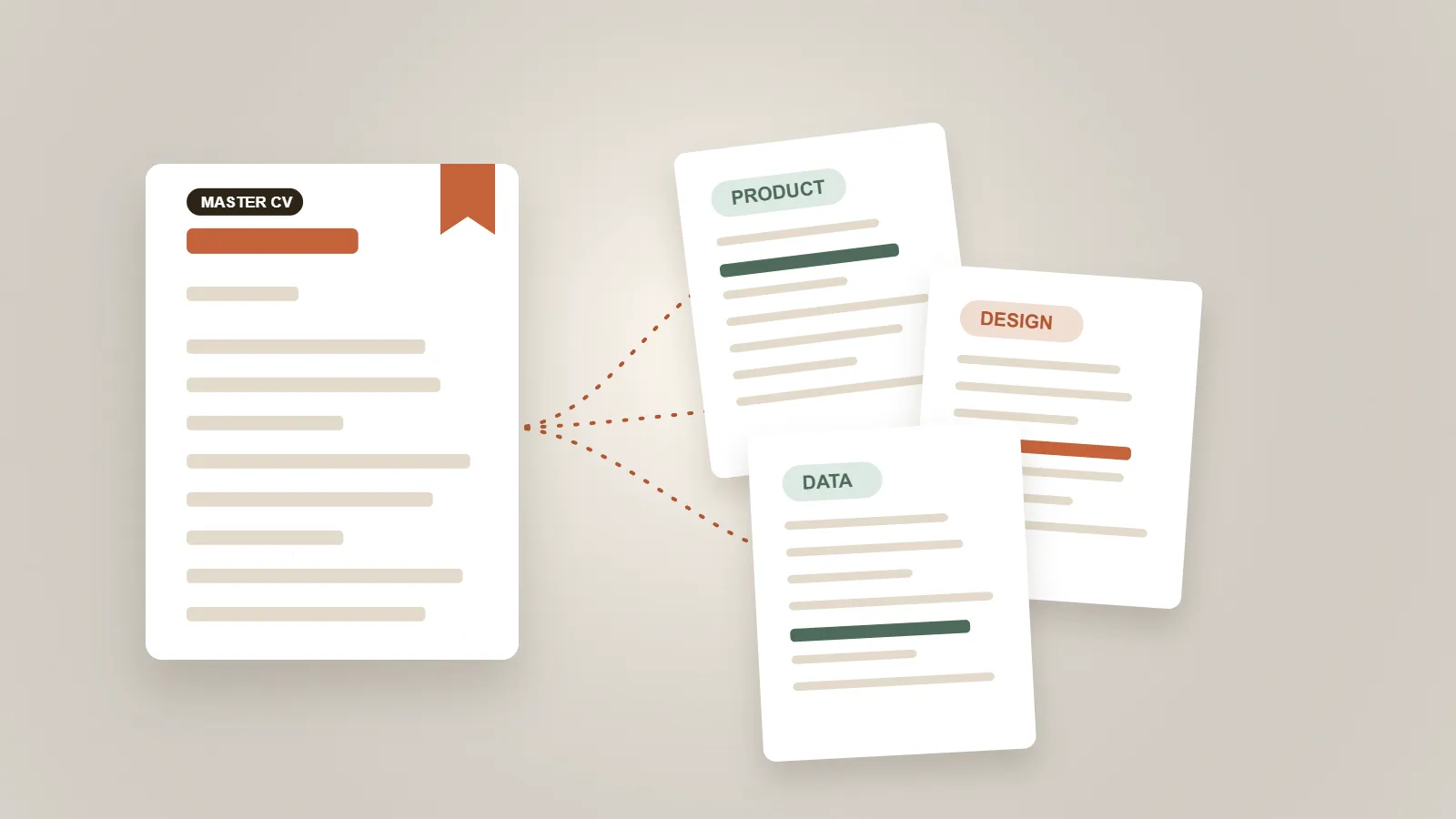
Most advice tells you to tailor your CV for every role. Most people don’t — because it sounds like rewriting the whole thing each time. It isn’t. Tailoring well is a small, repeatable edit to a strong base, and it gets faster the more you do it.
This post covers what’s worth tailoring, what to leave alone, and a process you can run in a few minutes per application.
Why tailoring beats a generic CV
A generic CV has to be vague enough to fit everything, so it lands as a strong match for nothing. A tailored CV does two useful things at once: it mirrors the language of the specific role (which helps both automated screening and the recruiter skim), and it puts the most relevant experience where it gets read first.
You are not inventing anything. You already have the experience — tailoring just decides which parts to lead with for this role.
What’s worth tailoring (and what isn’t)
You don’t touch most of your CV. Focus on the few parts that carry the match:
- The summary — two or three lines that frame you for this specific role, using the words the job ad uses where they genuinely apply to you.
- Skills — reorder so the must-haves from the job ad appear first; drop ones that aren’t relevant here.
- Your top bullets — under your most relevant role, lead with the achievements closest to what this job needs.
What stays the same: your employment history, dates, education, and the facts of what you did. Tailoring changes emphasis and wording, never the truth.
A repeatable process
- Read the job ad for its real requirements — the three or four things it keeps coming back to, not every bullet.
- Mirror the language where it’s honest — if you have the skill, use the ad’s term for it (spell out acronyms once).
- Reorder for relevance — move the most relevant skills and bullets up so they’re read first.
- Cut the noise — trim anything that doesn’t help the case for this role.
- Re-check before you send.
The first time takes a few minutes. By the tenth, you know your own material so well that it’s mostly reordering.
Make it compound, not repeat
The trap is treating every application as a blank page. The better way is to keep a strong master version of your experience — every metric, win, and skill you’ve confirmed — and tailor from it each time. Each application then builds on the last instead of starting over, and your tenth is far stronger than your first for the same effort.
That’s the idea behind Jude’s career-memory approach: it remembers what you’ve confirmed and what worked, so tailoring gets easier and your applications get stronger as you go.
Check it before you apply
Before you send a tailored CV, it’s worth confirming it still reads cleanly and reflects the role. You can run a free CV scan to see an ATS readability score, the keywords you match and miss for that specific job, and a short list of fixes.
A realistic expectation
Tailoring won’t guarantee an interview — no edit can, because every employer screens differently. What it does reliably is make your strongest, most relevant experience the easiest thing to see, for both the software and the human. That’s a sensible baseline before you apply, and it’s well within reach when you tailor from a strong base rather than from scratch.